When I first started teaching coding, one of the most challenging concepts to explain was binary numbers. How do computers think in 1s and 0s? Why can't they just use regular numbers like we do? These questions kept coming up, and I needed a better way to explain it.
The Light Bulb Moment
One day, while preparing a lesson, I looked up at the classroom lights and had an idea. What if I used light bulbs to teach binary? A light can be either ON or OFF - just like binary can be either 1 or 0. This simple analogy transformed how my students understood binary.
How It Works
Imagine you have a row of light bulbs. Each bulb can be either on (1) or off (0). With just one bulb, you can represent two states: off (0) or on (1).
With two bulbs, you can represent four different combinations:
- Both off: 00 (zero)
- Right on, left off: 01 (one)
- Right off, left on: 10 (two)
- Both on: 11 (three)
To better understand how binary numbers work, let's imagine a row of light bulbs. Each light bulb can be either on or off, which we can represent using a 0 or a 1. So, a row of light bulbs that is turned off would be represented by a string of 0s, like this:
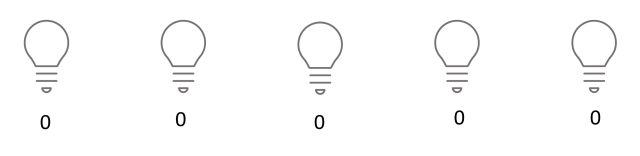
And a row of light bulbs that is turned on would be represented by a string of 1s, like this:
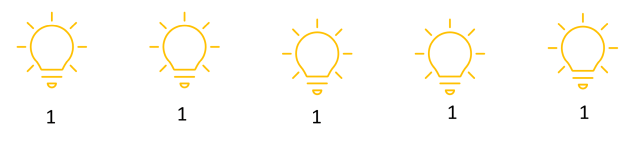
We can use these light bulbs to represent any number we want. For example, the number 3 could be represented like this:
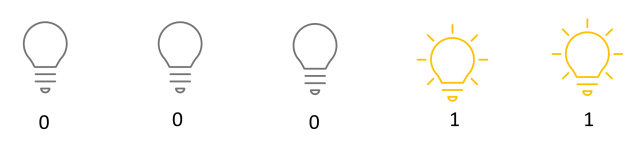
In this case, the first three light bulbs are turned off, and the last two are turned on. We can read this binary number just like we would read any other number, from right to left. The rightmost light bulb represents the number 1, the next light bulb represents the number 2, the next represents the number 4, and so on.
So in the above case, 00011 in binary is equal to 2 + 1 = 3 in decimal.
The Power Doubles
Here's where it gets interesting. Each time you add a bulb, you double the number of combinations you can make. Three bulbs give you 8 combinations (2³), four bulbs give you 16 (2⁴), and so on. With just eight light bulbs, you can count from 0 to 255!
Why Computers Use Binary
Computers use binary because they're built with billions of tiny switches (transistors) that, like our light bulbs, can only be in two states: on or off. By combining these switches in clever ways, computers can represent any number, any letter, any image, or any piece of information.
Try It Yourself
Here's a challenge: Using three light bulbs (or three fingers held up or down), try to represent the number 5. Remember, the rightmost position is worth 1, the middle is worth 2, and the leftmost is worth 4. Did you get 101? That's right - 4 + 0 + 1 = 5!
Understanding binary is fundamental to understanding how computers work at their core. And with the light bulb analogy, it's a concept that anyone can grasp, regardless of their background in math or computer science.